How to use AI writing tools for UGC scripts faster
Learn how to use AI writing tools for UGC scripts to draft, structure, and punch up ad scripts in minutes — then make them authentically yours.

I used to spend 45 minutes staring at a blank doc before filming a single UGC video. Hook, problem, solution, CTA — I knew the structure, but getting the words out felt like pulling teeth every time. Then I started using AI writing tools for UGC scripts, and that 45 minutes collapsed to about 8.
Not because AI writes my scripts for me. It doesn't. But it gives me something to react to instead of starting from nothing — and that's the whole game.
Why AI writing tools belong in every UGC creator's script process
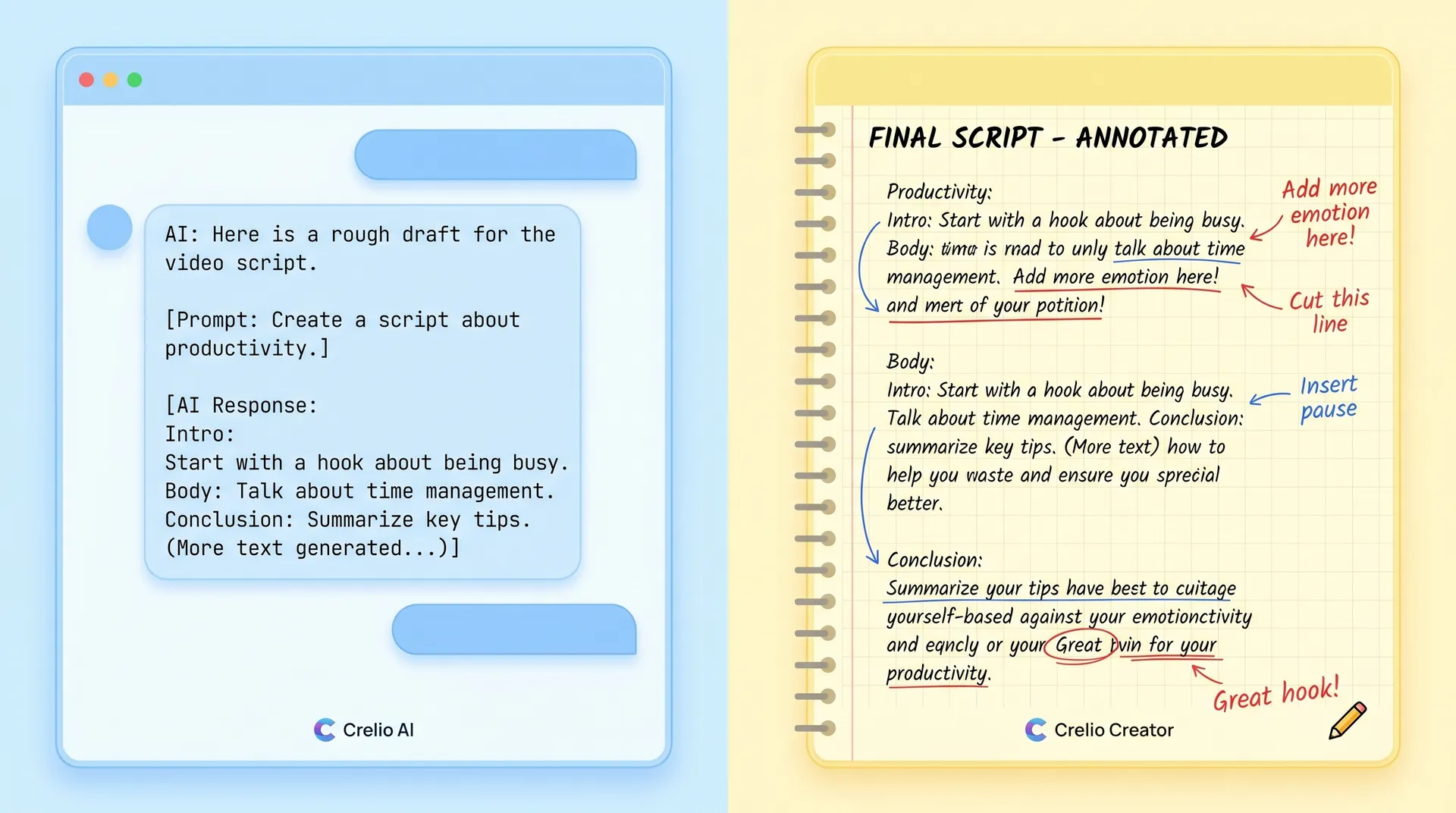
The blank page is the enemy. Your brain is great at editing and reacting, but it's terrible at generating on command under deadline pressure. AI flips the dynamic. You give it context, it spits out a draft, and you tear it apart and make it yours.
That's the only mental model that works here. If you copy-paste what the AI gives you straight onto your teleprompter, brands will feel it immediately. The script will be technically fine and completely lifeless. I've seen creators submit AI-written scripts word-for-word and get revision requests because it "sounds scripted." The irony.
But when you treat AI as a first-draft engine — something to spark structure and give you raw material — you get the speed benefits without sacrificing authenticity.
Think of it like a ghost-writing collab where you have final say on everything.
The tools actually worth using (and how to use them for UGC)
You don't need anything fancy. Most creators I know — including myself — get the best results from tools they already have access to.
ChatGPT (GPT-4o or later) is where I do 80% of my script drafting. It's fast, it takes detailed instructions well, and you can give it your tone, your niche, and the brand brief details in one message. The free tier works fine for occasional use. If you're producing more than 10 scripts a month, the $20/month Plus plan is worth it without question.
Claude (Anthropic) is my second pick, especially for scripts that need to feel more conversational and warm. It tends to write with slightly more nuance than GPT-4o, which matters for lifestyle and wellness UGC where the tone has to feel genuine.
Jasper and Copy.ai are built specifically for ad copy and script formats, which sounds like an advantage. In practice, they're more rigid. They work well if you want templated structure fast. They work less well if you want something that sounds like you.
The real unlock isn't the tool — it's the prompt.
My go-to prompt structure: "You are writing a 30-second UGC ad script for [brand name], a [product type] brand targeting [audience]. The hook should address [specific pain point]. Tone: [casual/warm/energetic]. Structure: hook → problem → solution → CTA. Keep sentences short and conversational. Draft 3 variations."
Three variations matters. Don't work from one draft. When you get three, you almost always want the hook from version one, the middle from version two, and you'll write your own CTA anyway because the AI version is always too generic.
My actual workflow: from brief to camera-ready in under 10 minutes
Here's exactly how I move from brand brief to filming-ready script.
Step 1: Feed it the brief, not a vague idea. Copy the actual product claims, target audience, and tone guidelines from the brief directly into your prompt. Don't paraphrase. The more specific the input, the better the output. If you haven't already, read how to read a UGC campaign brief first — it'll help you know exactly what to pull.
Step 2: Request multiple hooks first. Before asking for a full script, ask for 5-7 hooks only. This is where most UGC scripts live or die. Get the hook right, then build the script around it. A bad hook with a great body still loses. (If you want to go deeper on this, we have a full breakdown on UGC hooks that stop the scroll.)
Step 3: Generate the full draft using your chosen hook. Tell the AI which hook you're going with and ask for the full 30-second or 60-second script. Ask for it line-by-line with timing cues if you need them.
Step 4: Edit out loud. Read the draft aloud. Every line that makes you hesitate gets rewritten in your own words. This is where the script becomes yours. You're not replacing the AI's ideas — you're replacing its phrasing. Big difference.
Step 5: Add one personal detail. Drop in one thing the AI couldn't know: a specific personal experience with the product, a quirky observation, a piece of slang your audience uses. This single move is what separates "creator who uses AI" from "creator who sounds like AI."
The whole process, start to finish, runs me about 8-12 minutes for a 30-second script. Compare that to my old process. The math is obvious.
What AI still can't do (and you shouldn't ask it to)
AI writes in averages. It knows what most UGC scripts sound like because it was trained on thousands of them. So it will give you a competent script by default — one that hits the structure, addresses the pain point, includes a CTA.
But "competent" doesn't win campaigns in 2026. Brands are shifting budgets toward UGC creators precisely because they want authenticity — real humans with real reactions. If your script sounds like every other creator's AI output, you've eliminated your actual competitive advantage.
AI can't replicate your delivery quirks. It can't write the specific throwaway line you'll improvise on camera that ends up being the most engaging moment in the video. It can't know that your audience responds better to self-deprecating humor than aspirational framing.
Those things come from you. The AI just gets you off the starting line faster.
For the broader picture on where AI tools fit across your entire workflow — from research to editing to analytics — the best AI tools for UGC creators in 2026 full guide covers it all in one place.
Staying on-brief while moving fast
Speed is worthless if you submit something that misses the brief. A few rules I've built into my AI workflow to prevent that:
Before you finalize any AI-generated script, check it against these questions:
- Does the hook match the pain point the brand specified?
- Are all product claims accurate to the brief? (AI will sometimes invent plausible-sounding benefits that aren't in the brief. This will get your script rejected and damage your reputation.)
- Is the CTA exactly what was requested — app download, link in bio, website visit?
- Does the tone match the brand's existing content?
The product claims issue is the one that bites creators most. AI confidently makes things up. Always cross-reference every claim against the brief before you submit.
If you're building longer-term relationships with brands — the kind where you're submitting scripts regularly — accuracy and brief-adherence are what keep you in the rotation. That's the difference between a one-off gig and something closer to a brand ambassador arrangement.
The rate question: does faster scripting affect what you charge?
Short answer: no, and don't let brands tell you otherwise.
Your rate reflects the value of the deliverable, not the hours you spent on it. A script that converts at 4x ROAS isn't worth less because you wrote it in 8 minutes with AI help. It's worth exactly as much as it performs.
If anything, faster scripting means you can take more campaigns, which means more income. That's the actual benefit for your UGC rates and income — volume capacity, not cheaper work.